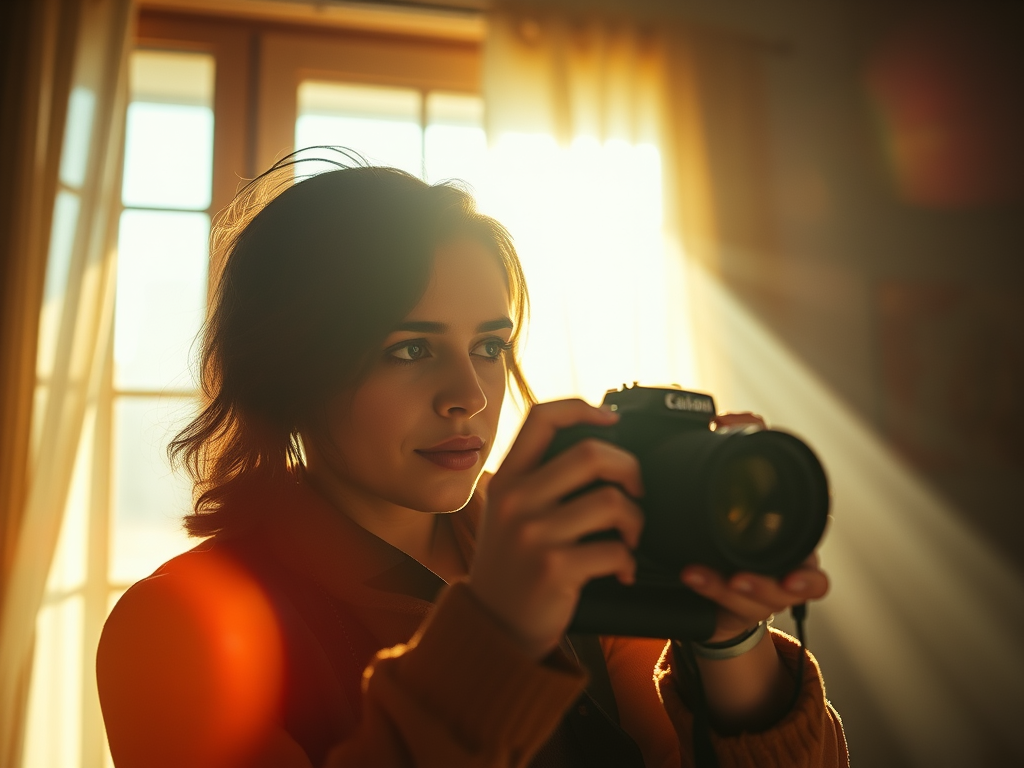
The Alchemy of the Instant
Unlike painting or sculpture, which are built from nothing, photography begins with everything—a flood of light from the world, caught and fixed. Yet, in that decisive split-second between opening and closing the shutter, an extraordinary transformation occurs. The photographer does not merely record; they interpret. They translate the three-dimensional, chaotic, fleeting stream of reality into a two-dimensional, composed, permanent image charged with meaning. This is the art of photography: the alchemical process of using a mechanical tool to capture not just light, but time, presence, and the profound emotion that resides in a single, arrested moment. It is the art of finding form in flux and revealing the extraordinary within the ordinary.
The Grammar of Light: More Than Illumination
In photography, light is not just the medium; it is the primary subject, the sculptor, and the emotive force. A photographer is first and foremost a student of light. They learn to read its quality—the harsh, defining lines of a noon sun versus the soft, forgiving wrap of window light. They manipulate its direction—side light to reveal texture, back light to create silhouette and mystery, front light to flatten and clarify.
This mastery of light creates mood and narrative before a subject is even considered. The deep, dramatic shadows and single stark highlight in a film noir still speak of suspense and moral ambiguity. The ethereal, fog-diffused light in a Sally Mann landscape evokes memory, loss, and the sublime. The stark, clinical flash of a Diane Arbus portrait isolates her subjects, creating a confrontational intimacy. Light becomes adjective and verb: it describes the world and acts upon it, revealing not just what things look like, but how they feel.
The Decisive Composition: Framing the World
With the camera, the photographer performs a radical act: they frame the world. This rectangle excludes more than it includes, demanding choice. What stays in? What is left out? This act of selection and arrangement is where photography’s art converges with painting’s. Compositional principles—the rule of thirds, leading lines, negative space, balance—are used not as rigid rules, but as tools to guide the viewer’s eye and mind.
The concept of the “decisive moment,” coined by Henri Cartier-Bresson, is the apex of this principle. It is the precise alignment of form, content, and emotion in a fleeting instant. It is the leap of a man over a puddle perfectly mirroring the shapes on a poster behind him; it is the exact expression on a face that tells an entire story. The photographer’s genius lies in anticipating and recognizing this convergence, freezing a slice of time that feels both spontaneous and inevitable.
Beyond Documentation: Photography as Emotion and Idea
While its birth was rooted in documentation, photography swiftly matured into a potent medium for subjective expression and conceptual exploration. Different genres have evolved to channel this power.
Portraiture moved beyond likeness to become a psychological excavation. Richard Avedon used the blank white backdrop and unflinching gaze to strip his subjects bare, revealing character, vulnerability, and the marks of lived experience. Cindy Sherman used the self-portrait to construct and deconstruct identities, questioning stereotypes and the very nature of representation.
Street Photography, as practiced by Vivian Maier or Garry Winogrand, finds chaotic poetry in the public theater of everyday life, revealing humor, pathos, and the strange beauty of the mundane.
In the conceptual realm, photographers like Hiroshi Sugimoto use the camera to photograph ideas. His seascapes dissolve into minimalist gradients of gray, meditations on time and primordial memory. His theater series uses a single long exposure to turn a movie screen into a radiant, empty white rectangle—a photograph of time itself.
The Digital Age and the Democratization of Vision
The digital revolution has transformed photography from a chemical process to an electronic one, democratizing the medium and exploding its possibilities. The smartphone has made everyone a potential photographer, shifting the cultural role of the image from rare artifact to ubiquitous communication.
This has expanded the art form in two key ways. First, post-processing has become a digital darkroom of infinite potential. Color grading, compositing, and manipulation allow photographers to build images that transcend the literal capture, creating hyper-real or surreal worlds that express inner states. Second, the instantaneous and shareable nature of digital images has given rise to new visual languages and social documentary forms, from the curated aesthetic of Instagram to the urgent witness of citizen journalism.
Yet, the core art remains unchanged. It is the sensitivity to light, the discipline of the frame, and the insight to recognize the moment when the external world aligns with an internal truth. A great photograph is a quiet manifesto. It says: Look here. Feel this. This moment, this light, this face mattered. It proves that the most powerful art is often not about creating something new, but about seeing what is already there with such clarity and compassion that it is forever changed.

Leave a Reply